
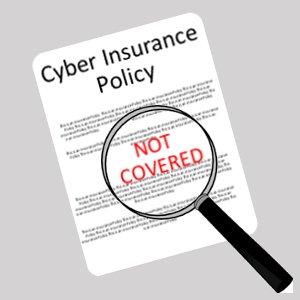
When the front lines of IT security fail and a cyber breach occurs, businesses often rely on insurance to reduce the often extreme financial impact associated with the breach. Policies are usually written to ensure that the insured recovers extra expenses incurred and are covered for fines and penalties placed on the company by regulatory agencies.

Traditionally, a cyber breach occurs and otherwise private information is stolen or made public resulting in costs such as notification expenses, IT forensics, data recovery, public relations/crisis management, legal defense, business interruption, brand/reputation damage and regulatory fines and penalties; just to name a few. However, the breadth of cyber-attacks has proven to be ever expanding. Now, breaches resulting in physical property damage are being reported more regularly which leads to the immediate question, “am I covered for such an event?

If you’re anything like me, you will complete most of your holiday shopping from the comfort of your own home, laptop in hand, attempting to avoid the craziness of department stores and mall parking lots. Then, a week or so before the big day, you’ll realize that you neglected to order some key gifts and scramble to pick them up in-store.
The year 2016 is turning out to be a record one for data breaches, and cybercrime won’t be slowing down any time soon. According to global digital security firm Gemalto, nearly five billion private records have been exposed globally since 2013. Data breaches were up 15% in the first half of 2016 compared to the prior six months.

Every organization is faced with risks and needs to practice some form of risk management in order to maintain the health of the entity. Many take a traditional approach, where risk is managed in silos, with each leader of a business unit (sales, operations, finance, HR, etc.) responsible for managing the risks that fall within his or her area of responsibility.
Does the threat of Ransomware crippling your organization’s network and operations keep you up at night? At this point, it kind of should. However, there’s a lot your CISO and IT staff could be doing to mitigate the threat and help you sleep a bit more soundly.

Troubles continue for Millennium Tower, the luxury high-rise building that has been coined “the leaning tower of San Francisco” for tilting two inches at its base and sinking 16 inches. As we predicted in our August 11th blog, a lawsuit ensued and it’s huge: Condo owners filed a $500 million class-action lawsuit against the developers, Millennium Partners, and the Transbay Joint Powers Authority.
