

We manage more than a quarter billion dollars of premiums for a diverse range of clients around the globe.

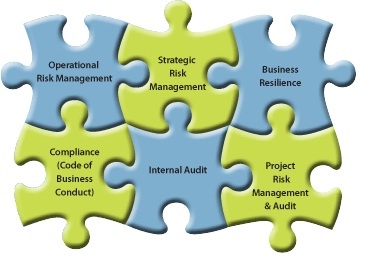
Every organization is faced with risks and needs to practice some form of risk management in order to maintain the health of the entity. Many take a traditional approach, where risk is managed in silos, with each leader of a business unit (sales, operations, finance, HR, etc.) responsible for managing the risks that fall within his or her area of responsibility.
Risks pose threats to a broad range of your organization’s resources, such as assets, company reputation or time. These resources are spread throughout a variety of potential risk owners. In turn, each risk owner may have access to only certain capabilities for addressing risk. For example:
An Enterprise Risk Management (ERM) process can yield a valuable communication for your organization: the Risk Appetite Statement. This statement serves an important assurance role for stakeholders in your company, and is an indicator of critical, board or executive-level oversight of risk management. It serves as a tangible product of an effective effort to assess and control risk across the enterprise. It can be referenced as the basis for any communication or disclosure your company may need to make about its risk management policy and efforts.
Sleep-at-Night Assurance: Integrating Enterprise Risk Management and Project Management
Last week, I attended an excellent Enterprise Risk Management (ERM) workshop hosted by NC State University which highlighted the myriad of issues impacting the maturity of ERM within organizations.
A constant struggle for the risk manager of an organization is balancing the profitability expectations of its shareholders and maximizing operational efficiency of the risk management team in order to reduce the organization’s Total Cost of Risk (TCoR). Having a clear perspective of the organization’s appetite for risk and risk tolerance is a fundamental element needed in order to achieve this balance.
The recent Enterprise Risk Management (ERM) Workshop held by North Carolina State University was chock full of valuable information. It was attended by seasoned risk and audit professionals all looking for ways to improve the effectiveness of their own ERM programs.
While it was never the intent of Winston Churchill that his famous description of Russia’s intentions in 1939 would apply to Enterprise Risk Management (ERM), the analogy applies pretty well. “It is a riddle, wrapped in a mystery, inside an enigma, but perhaps there is a key.” I firmly believe there is a key to a proper, productive and easily understood ERM program.
A few weeks ago I attended the Enterprise Risk Management (ERM) Roundtable Summit held by NC State University. Although there were many speakers from a number of different industries, the same theme resonated throughout the day. The theme was, in order for any organization to have a successful ERM process it must foster thoughtful discussions between those who are tasked with ERM. As we have mentioned previously, it is easy for ERM to become just another “compliance check-box.” However, encouraging a challenging dialogue among team members can certainly help your organization move past the “check-box” mentality.